Detection As Code
Detection rules kept the way code is kept: written once in Sigma, version-controlled, linted and tested in CI, and compiled to whatever SIEM is in front of me. I spend my day tuning rules in Sentinel and Splunk by hand; this is that work done as a pipeline instead of a console...
- ▸.github/
- ▸workflows/
- ▸docs/
- ▸screenshots/
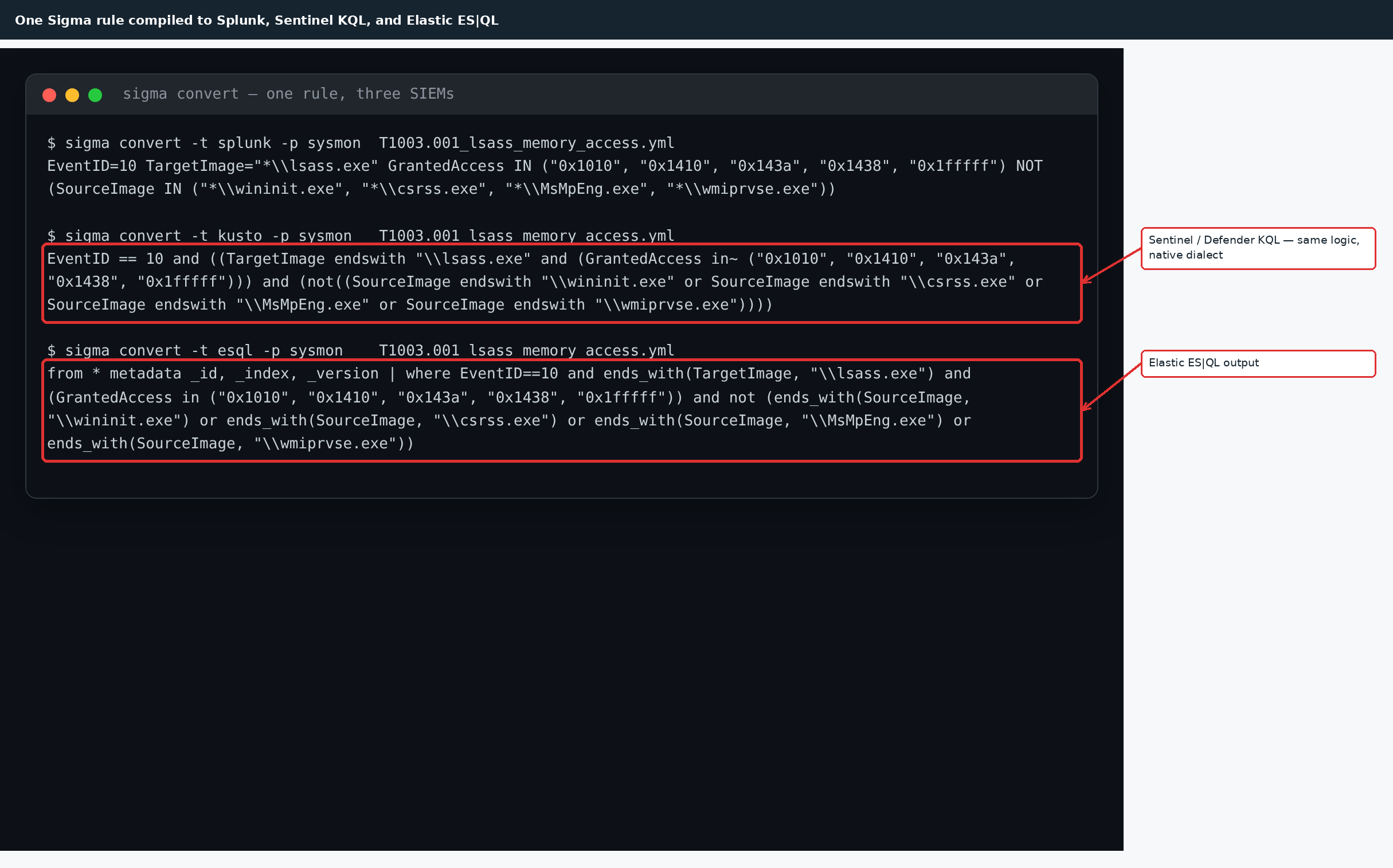
- □01-multi-siem-conversion.png
- ▸rules/
- ▸linux/
- ▸credential-access/
- ▸execution/
- ▸persistence/
- ▸windows/
- ▸credential-access/
- ▸defense-evasion/
- ▸execution/
- ▸initial-access/
- ▸persistence/
- ▸tests/
- ▸tools/
Detection-as-Code
Detection rules kept the way code is kept: written once in Sigma, version-controlled, linted and tested in CI, and compiled to whatever SIEM is in front of me. I spend my day tuning rules in Sentinel and Splunk by hand; this is that work done as a pipeline instead of a console click.
Every rule here converts cleanly to Splunk SPL, Elastic ES|QL, and Microsoft Sentinel / Defender KQL, and is tagged to MITRE ATT&CK so coverage is something you can measure instead of guess at.
Why
A detection written in one SIEM's query language is stranded there. Writing it in Sigma once and compiling it means the same logic ships to Splunk, Elastic, and Sentinel without re-deriving it - and the rule gets reviewed, diffed, and tested like any other code. The goal is fewer false positives and provable coverage, not more dashboards.
Layout
rules/
  windows/   credential-access, execution, persistence, defense-evasion, initial-access
  linux/     credential-access, execution, persistence
tools/convert.py        compile every rule to Splunk / Elastic / Sentinel
tests/test_rules.py     schema, ATT&CK tagging, unique IDs, correlation references
.github/workflows/      lint -> test -> convert on every push
dist/                   generated queries (CI artifact; gitignored)
The rules
Ten detections across both platforms, each mapped to ATT&CK and tuned past the naive
version (e.g. LSASS access filtered to the granted-access masks tooling actually uses, not
the broad 0x1010). Full table in docs/coverage.md.
| Technique | Detection | Platform |
|---|---|---|
| T1003.001 | Suspicious LSASS process access | Windows |
| T1059.001 | PowerShell EncodedCommand | Windows |
| T1566 / T1059.001 | Office spawns scripting host / LOLBin | Windows |
| T1218.011 | Suspicious rundll32 | Windows |
| T1543.003 | New service installed | Windows |
| T1053.005 | Scheduled task created | Windows |
| T1110 | SSH brute force (correlation) | Linux |
| T1059.004 | Reverse shell one-liner | Linux |
| T1543.002 | Systemd persistence | Linux |
Use it
pip install -r requirements.txt
sigma check rules/            # lint
pytest -q                     # schema + ATT&CK validation
python tools/convert.py       # compile to dist/{splunk,esql,kusto}/
Convert a single rule on the fly:
sigma convert -t splunk -p sysmon rules/windows/credential-access/T1003.001_lsass_memory_access.yml
sigma convert -t kusto  -p sysmon rules/windows/credential-access/T1003.001_lsass_memory_access.yml
convert.py picks the right processing pipeline per rule from its logsource (Sysmon for
process/file telemetry, Windows-audit for Security/System channels). Correlation rules like
the SSH brute force are compiled together with the base rule they reference - make correlations does that, since they need their referenced rule in the same collection.
Validation
CI lints with sigma check, runs the schema/ATT&CK test suite, and compiles all rules to
the three backends, failing on any conversion error. The rules themselves are validated
behaviourally in the companion purple-team lab - Atomic
Red Team fires each technique and the matching detection is confirmed in the Wazuh SIEM
before a rule is promoted here. The Wazuh-native versions of several of these live in the
SOC automation lab.